
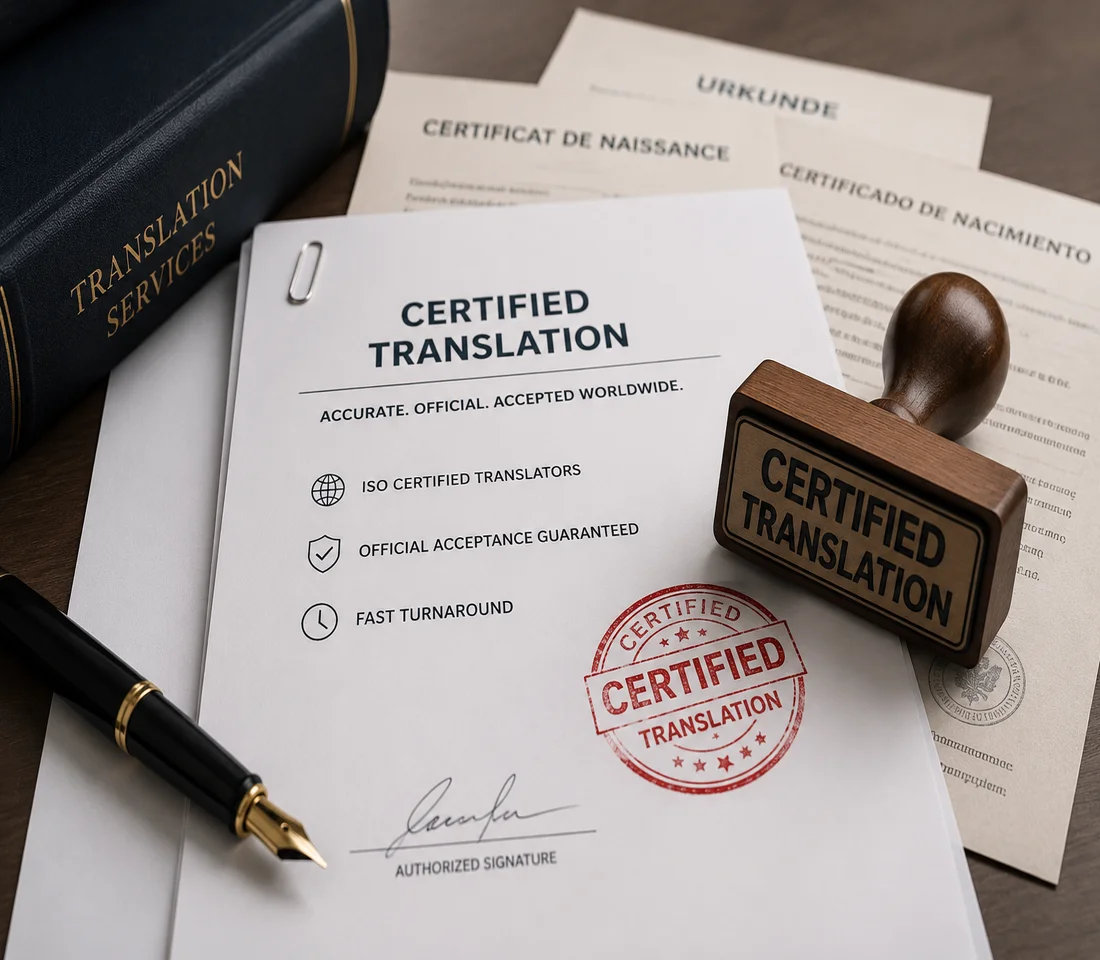
If you’ve been told you need a certified translation — for an immigration filing, a court submission, a university application, or a business contract — you’ve probably already discovered that the term means different things to different people. Some institutions say “certified.” Others say “notarized.” A few require both. And the price quotes you’ve received probably range from $15 a page to $70 a page, with no clear explanation of why.
This article explains what certified translation actually is, what it is not, what New York institutions and federal agencies actually require, and what professional certified translation costs in 2026 — so you can make an informed decision before you commission the work.
What Is a Certified Translation?
A certified translation is a translated document accompanied by a signed Certificate of Accuracy — a formal written statement in which the translator certifies that the translation is a complete and accurate representation of the original document, and that the translator is competent to perform the translation.
The Certificate of Accuracy is typically printed on company letterhead and signed by the translator or an authorized representative of the translation company. It is not a government-issued document. There is no official certification body in the United States that licenses translators the way that lawyers or doctors are licensed. The certification is a professional attestation — and the institution receiving the document accepts it based on the reputation and qualifications of the translation provider.
This is an important distinction: in the United States, any competent translator can certify their own translation. What matters to the receiving institution is that the certification is accurate, complete, and presented on professional letterhead.
What Is a Notarized Translation — and Is It the Same Thing?
No — and the confusion between these two terms causes more problems than almost anything else in the certified translation space.
Certification refers to the translator’s attestation of accuracy. It is about the quality and completeness of the translation itself.
Notarization is performed by a Notary Public, who witnesses and authenticates the translator’s signature. A Notary Public does not verify the accuracy of the translation — they are simply attesting that the person who signed the certificate is who they say they are.
Some institutions require only certification. Others require both certification and notarization. A small number of international submissions require an Apostille — a further authentication of the notary’s signature recognized under the Hague Convention.
Before commissioning any certified translation, confirm exactly what the receiving institution requires. USCIS, for example, requires certification but does not require notarization for most filings. New York State courts have their own requirements that differ from federal requirements. If you’re not sure, reach out to us directly — we’ll tell you exactly what you need before any work begins.
When Is a Certified Translation Required?
The most common situations requiring certified translation in New York:
- Immigration filings — USCIS regulations (8 CFR 103.2(b)(3)) require that all documents in a foreign language submitted with an immigration petition be accompanied by a full English translation certified by a competent translator. This includes birth certificates, marriage certificates, divorce decrees, police clearance letters, and supporting financial documents.
- Court submissions — Federal and New York State courts require certified translation of all foreign-language evidence and supporting documents. Requirements vary by court and judge — always confirm with your attorney.
- University and academic applications — Most U.S. universities require certified translation of foreign transcripts, diplomas, and academic records. Some also require a credential evaluation from a recognized body such as WES or ECE.
- Business contracts and agreements — Contracts executed in a foreign language that are submitted to U.S. courts or government agencies typically require certified translation. International mergers, acquisitions, and licensing agreements often require certified translation of supporting corporate documents.
- Medical and healthcare — Foreign medical records, pathology reports, and pharmaceutical documentation submitted to U.S. hospitals, insurers, or regulatory agencies typically require certified translation.
- Real estate and financial transactions — Foreign-language deeds, mortgage documents, and financial statements submitted to New York title companies, banks, or lenders may require certified translation.
What Does Certified Translation Cost in New York in 2026?
The New York market for certified translation is wide — prices vary significantly depending on the provider model, the language pair, and whether notarization is included. Here is where the market sits in 2026:
| Provider type | Price range (per page) | Includes notarization? | Typical turnaround |
|---|---|---|---|
| Budget online services | $14 – $25 per page | No — add-on extra | 24–48 hours |
| Mid-market agencies | $25 – $45 per page | Sometimes included | 24–72 hours |
| In-house NYC firms (e.g. Gotham Lab) | $35 – $55 per page | Available in-house | 24–48 hours |
| Law firm or court-affiliated | $55 – $100+ per page | Often included | 3–7 business days |
Rates reflect 2026 market pricing for standard documents (birth certificates, marriage certificates, diplomas) in common language pairs. Complex legal documents, rare languages, and large-volume projects are priced differently. Always request a project-specific quote.
At Gotham Lab, our certified translation rates are published transparently on our certified translation services page. We do not charge per-page rates that vary by document complexity without telling you in advance. If notarization is required, we handle it in-house — you do not need to find a separate Notary Public.
What Affects the Cost?
Several factors move the price above or below the standard market range:
- Language pair — Common pairs (Spanish to English, French to English, Portuguese to English) are priced at the lower end. Less common languages — Haitian Creole, Amharic, Bengali, Pashto — require specialist translators and are priced higher.
- Document complexity — A one-page birth certificate is the simplest certified translation there is. A 40-page legal contract with technical terminology in multiple sections is priced accordingly.
- Turnaround time — Standard turnaround for most certified documents is 24–48 hours. Rush delivery (same day or next morning) carries a premium at most providers.
- Notarization — If notarization is required in addition to certification, expect an additional $20–$40 per document at most providers.
- Apostille — If the document is for international use and requires an Apostille from the New York Secretary of State, this is an additional process typically costing $75–$150 depending on the service provider and filing method.
What to Look For in a Certified Translation Provider
In a market where prices range from $15 to $70 per page, the question is not just what it costs — it’s what you’re getting for that cost. Here is what to evaluate:
- In-house translators vs. freelance networks — Many translation agencies outsource to freelancer networks. The translator who works on your document may be anywhere in the world, with no direct accountability to the agency you hired. At Gotham Lab, all certified translation is handled in-house by our New York City team.
- Subject-matter expertise — A certified translation of a legal brief requires a translator with legal expertise. A medical record requires someone with clinical terminology knowledge. Generalist translators produce generalist results.
- Quality review process — Professional certified translation involves at minimum a two-stage process: translation and independent editing. Single-pass translation — one translator, no review — is faster and cheaper and produces more errors.
- Acceptance guarantee — Reputable providers stand behind their work. If a certified translation is rejected by the receiving institution due to a translation error, the provider should correct it at no charge. We guarantee acceptance of all certified translations at Gotham Lab — if there is an error, we fix it.
- Confidentiality — Certified translation documents frequently contain sensitive personal information — immigration records, medical histories, financial statements. Confirm that the provider has a documented confidentiality policy and does not route documents through unsecured third-party platforms.
Certified Translation for Spanish, French, Haitian Creole, and Other Languages in New York
New York City is one of the most linguistically diverse cities in the world — and our certified translation requests reflect that. The most common language pairs we handle for certified documents:
- Spanish to English — the highest-volume certified translation language in New York, driven by immigration filings, court submissions, and academic applications
- French to English — including Canadian French and West African French variants
- Haitian Creole to English — one of New York City’s most spoken languages, with high demand for immigration and legal certified translation
- Arabic, Mandarin, Russian, Polish, Bengali, Urdu, Korean — all handled in-house by subject-matter specialist translators
If your language is not listed here, contact us — we work across 50+ languages for certified document translation.
Working With Gotham Lab for Certified Translation
Gotham Lab has been producing certified translation for New York’s legal, business, and immigration communities since 2007. Our in-house team handles every step — translation, quality review, certification, and notarization if required — from our Midtown Manhattan office at 340 West 42nd Street.
We provide same-day quotes on all certified translation requests. For standard documents, turnaround is typically 24–48 hours. Rush delivery is available. If you’re not sure exactly what certification level your institution requires, tell us who the document is going to — we’ll tell you what you need.
Learn more about our certified translation services or contact us directly for a same-day quote.
Comments are closed