
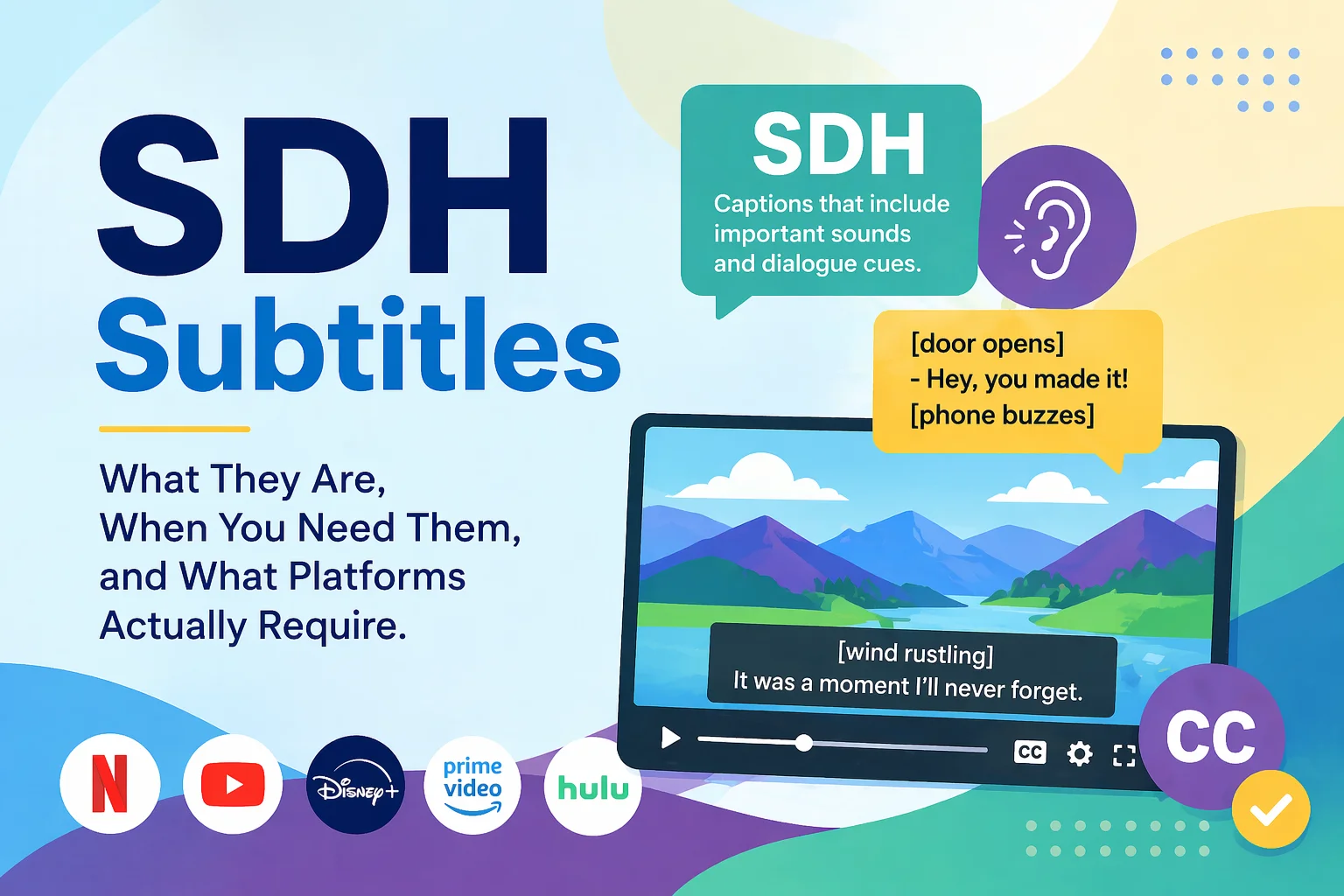
SDH Subtitles: What They Are, When You Need Them, and What Platforms Actually Require
SDH stands for Subtitles for the Deaf and Hard of Hearing, subtitle tracks that include dialogue plus speaker identification, sound effects, and music cues, unlike standard subtitles, which transcribe dialogue only. Netflix, Amazon Prime Video, Disney+, and Apple TV+ all require SDH tracks (not traditional closed captions) for streaming delivery. Netflix requires SDH in TTML1 format exclusively; most other platforms accept SRT or WebVTT.
If you’ve ever ordered subtitles for a film or video project and been asked whether you need SDH, you’ve encountered one of the more consistently misunderstood distinctions in post-production. The short answer is that SDH and standard subtitles are not the same thing — and on major streaming platforms, they are not interchangeable.
Here’s what you need to know.
What SDH stands for — and what it actually means
SDH stands for Subtitles for the Deaf and Hard of Hearing. The name tells you most of what you need to know: these subtitles are designed for viewers who cannot hear the audio, rather than viewers who simply don’t understand the language.
Standard subtitles transcribe spoken dialogue. That’s their job, and for a hearing viewer watching foreign-language content, that’s enough. SDH goes further. In addition to the dialogue, SDH includes speaker identification, relevant sound effects, and non-verbal audio cues that a deaf or hard-of-hearing viewer would otherwise miss entirely — things like [door slams], [tense music building], or [phone ringing in the distance]. It also identifies who is speaking when that isn’t visually clear from the frame. The result is that a viewer watching with SDH enabled gets a meaningfully more complete picture of what’s happening on screen — not just what’s being said, but the sonic environment the story is taking place in.
SDH vs. closed captions — the distinction that matters for delivery
SDH and closed captions serve the same audience and contain the same categories of information: dialogue, speaker ID, sound effects, music cues. The difference is technical and has real implications for how you deliver your files.
Closed captions are encoded into the video signal using dedicated data channels — CEA-608 for standard definition, CEA-708 for HD — and are the standard for North American broadcast television. They can be toggled on and off by the viewer. Closed captions are what the FCC mandates for U.S. broadcast programming.
SDH is delivered as a subtitle track in standard formats — SRT, VTT, TTML — and is the standard for streaming and digital distribution. Netflix, Amazon Prime Video, Disney+, and Apple TV+ all use SDH tracks, not traditional closed captions, for their accessibility subtitle requirements. This matters practically when you’re preparing a delivery package. Submitting a closed caption file where an SDH track is required — or vice versa — will result in rejection.
When streaming platforms require SDH
Every major streaming platform requires SDH for English-language content, and most require it for all languages in which the content is being distributed. The specifics vary by platform.
Netflix requires SDH to be delivered in TTML1 format (.xml or .ttml). The SDH track must encompass all spoken dialogue intended to be understood, including any dialogue in secondary languages present in the content. Netflix’s style guide specifies that dialogue in SDH should not be paraphrased — transcriptions must stay as close to the audio as possible, preserving dialect, slang, and spoken word order. Speaker identification and sound effect notation follow specific formatting conventions that differ from standard subtitle formatting.
Netflix introduced a separate dialogue-only subtitle option in April 2025 — a track that includes only spoken dialogue without audio cues, for hearing viewers who simply prefer reading along. This is a distinct track from SDH and does not replace it. Both tracks are now standard in a complete Netflix delivery package for English-language content. Amazon Prime Video, Disney+, and Apple TV+ have similarly detailed SDH requirements, with platform-specific formatting rules for sound effect notation, music cues, and speaker identification. If you are preparing content for multi-platform distribution, the SDH track will need to conform to the most restrictive specification in your delivery list — typically Netflix’s.
What good SDH production actually involves
This is where SDH production diverges most clearly from standard subtitling, and where the difference between a professional SDH track and an amateur one becomes apparent.
Beyond transcribing dialogue, an SDH subtitler makes editorial decisions about which sounds to include and how to describe them. Not every sound effect warrants a notation — including too many creates visual clutter that degrades the viewer experience. The standard is to include sounds that are narratively significant: sounds that hearing viewers would register as meaningful, that create tension, establish setting, or carry emotional information.
Sound effect notations use brackets and follow consistent formatting throughout the file. Speaker identification appears when it isn’t visually clear — typically in dialogue-heavy scenes with multiple speakers, or when a character speaks off-screen. Music cues are noted when the type of music carries meaning: [ominous orchestral music] communicates something [upbeat pop music] does not. Consistency across the file is non-negotiable. Bracket style, capitalization, terminology, and sound effect descriptions follow the same conventions from the first subtitle to the last. A professional SDH track reads as if one person made all the decisions — because in a well-run production, one person did.
ADA, the European Accessibility Act, and why the compliance window matters now
Legal requirements for SDH-level accessibility are tightening in both the U.S. and Europe, and the deadlines are immediate.
In the United States, ADA Title II was updated to require government entities and public-facing web content to meet WCAG 2.1 AA accessibility standards by April 24, 2026. While the regulation doesn’t specify “SDH” by name, the caption requirements under WCAG 2.1 AA effectively mandate SDH-level detail — including non-speech audio and speaker identification — for video content.
The European Accessibility Act came into force on June 28, 2025. It applies to digital services — including video content — sold or distributed in EU member states, with requirements that similarly mandate accessibility features equivalent to SDH for deaf and hard-of-hearing users. For content producers, broadcasters, and institutions distributing video in either market, the compliance question is no longer whether SDH is required — it’s whether your current content meets the standard.
File formats for SDH delivery
The file format requirements for SDH depend on the platform and distribution channel:
- Netflix: TTML1 (.xml or .ttml). No other format is accepted without a pre-approved exception from your Netflix representative. SRT and VTT are not accepted for Netflix SDH delivery.
- Most other streaming platforms and digital distribution: SRT (.srt) and WebVTT (.vtt) are widely accepted. Always confirm with your distributor before preparing files.
- Broadcast: SDH is not typically used for broadcast delivery — closed captions in CEA-608 or CEA-708 format are the broadcast standard in the U.S.
Film festival delivery: Requirements vary by festival. Most major festivals — Sundance, Tribeca, Cannes, TIFF — accept SRT for digital screening. SDH-formatted SRT files are appropriate for digital festival delivery when the festival does not require burned-in captions.
When you need SDH versus standard subtitles
Standard subtitles are appropriate when your content is being distributed to hearing audiences who speak a different language — a French film being shown in the U.S., or an English corporate video being distributed in Germany.
SDH is required when your content is being delivered to a streaming platform, broadcast network, or institution that mandates accessibility compliance — which now means most professional distribution contexts. It is also the right choice when your content has a significant U.S. or European audience, regardless of whether a platform explicitly requires it.
When you’re unsure, the practical answer is: produce SDH. An SDH track serves both accessibility requirements and standard subtitle viewing contexts. A standard subtitle track cannot be substituted for SDH without rework.
At Gotham Lab, we produce SDH tracks for streaming platform delivery, film festival distribution, and broadcast compliance from our in-house New York City studio. We also offer full CCSL services for film distribution. If you have a project that needs SDH — or aren’t sure which subtitle format your delivery package requires — you can reach us at info@gothamlab.com or +1 347-587-8110, or visit gothamlab.com/subtitling-services/.
Frequently Asked Questions
Contact Gotham Lab: info@gothamlab.com | +1 347-587-8110 | 340 W 42nd St #2424, New York, NY 10108
Comments are closed