
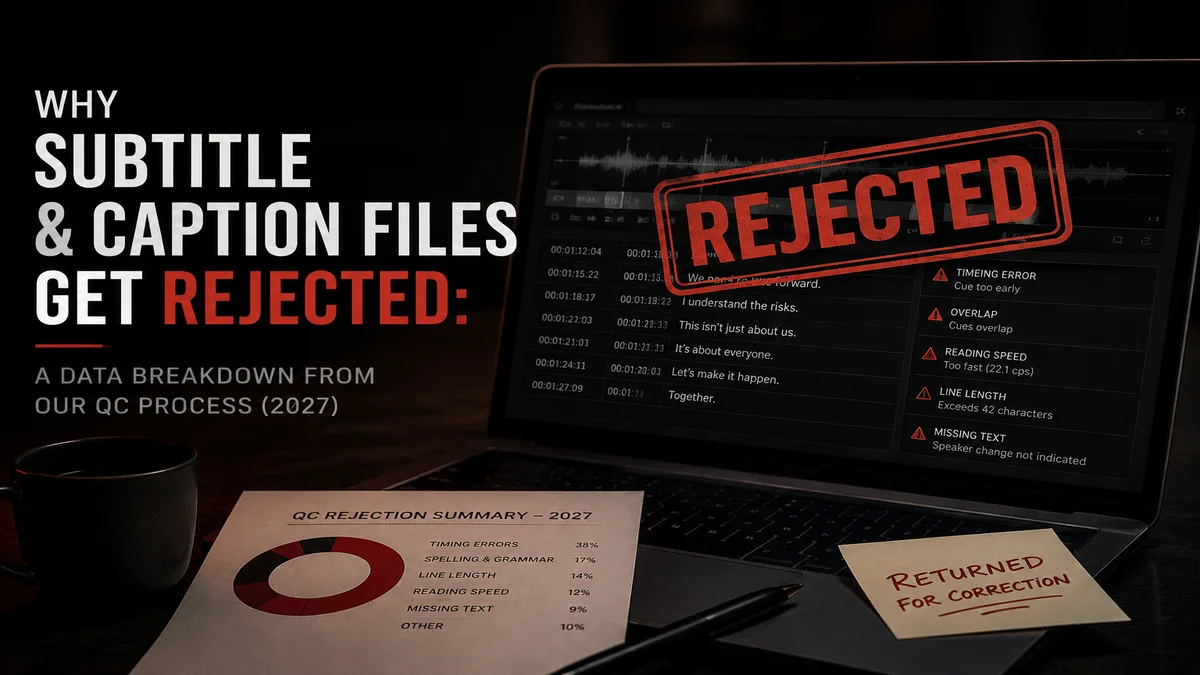
Every subtitle and caption file we produce goes through internal QC before it ever reaches a client or a platform. Over years of reviewing files, both our own productions and files we’re brought in to fix after a rejection from another vendor, a clear pattern has emerged: the vast majority of rejections have nothing to do with translation quality. They’re technical formatting issues that are entirely preventable.
Character and line limits (≈60% of rejections)
This is overwhelmingly the top cause, and it’s also the one most production teams underestimate. For FCC-compliant closed captions, the standard limit is 32 characters per line with a maximum of two lines on screen at once. Files that exceed this, whether from dense dialogue, long speaker names, or captions that weren’t re-broken for the format, get flagged immediately.
This is where a lot of confusion comes from: streaming platforms don’t all use the same limit. Netflix’s own subtitle spec allows up to 42 characters per line, a completely different number from the FCC broadcast standard. A file built correctly for one destination can still fail QC at another if the line lengths aren’t adjusted for where it’s actually being delivered. This is also true across festival deliveries: our film festival subtitle requirements guide covers how formatting specs shift again for Sundance, Cannes, and other festival submissions.
Reading speed (≈20% of rejections)
Reading speed is measured in characters per second (cps): the FCC/broadcast standard caps adult programming at 20 cps and children’s content at 17 cps. When captions display faster than a viewer can realistically read them, especially during fast-paced dialogue, the file gets flagged regardless of how accurate the text itself is. We cover platform-specific reading speed limits, including Netflix’s own thresholds, in more detail in that same delivery guide.
Missing descriptive text (≈15% of rejections)
SDH and closed captions are required to include more than spoken dialogue: sound effects (door closes), ambient audio (birds singing), music cues, and speaker identification for off-screen or unclear speakers. Files that only transcribe dialogue and skip this contextual information don’t meet accessibility standards, even if every word of speech is captured correctly. This is one of the more common gaps we see in files that come from teams handling captions in-house without dedicated SDH experience.
Translation quality and censorship (≈5% of rejections)
The smallest but highest-stakes category: subtitles rejected for poor translation quality, or for failing to apply required censorship to profanity where the delivery platform or broadcast standard requires it. Low frequency, but often the most costly to catch late, since it typically requires a full retranslation rather than a technical reformat. For international deliveries specifically, requirements vary further by platform, our Amazon Prime Video subtitle requirements guide covers territory-specific rules that add another layer to this.
What this means for your production
The pattern in our own QC data is clear: the majority of rejections aren’t translation or content problems, they’re technical formatting issues that are entirely preventable with the right process before delivery. That’s the value of working with a team that checks against destination-specific specs before submission, not after a platform sends it back.
Avoid the rejection cycle entirely
Gotham Lab produces subtitles and closed captions in-house, checked against the specific format requirements of your delivery destination before submission, not after a rejection notice.
View Subtitling ServicesFrequently Asked Questions
Download the full dataset (CSV)
This dataset is licensed under CC BY 4.0, free to share and republish with attribution to Gotham Lab.
Comments are closed